


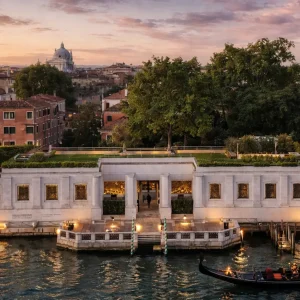
There are exhibitions that you simply visit, and others that you experience slowly, letting materials, gestures, and silences guide the journey. Mani-Fattura: the ceramics of Lucio Fontana, on view from 11 October 2025 to 2 March 2026, clearly belongs to the latter category.
Hosted at the Peggy Guggenheim Collection, overlooking the Grand Canal, the exhibition offers an unexpected and deeply human perspective on one of the most iconic artists of the twentieth century. Here, Fontana moves away from the slashed surfaces for which he is best known and returns to matter, to the hands, to direct contact with clay. A warmer, more intimate language that invites visitors to observe and to feel, not only to understand.
A Fontana to be discovered slowly
Curated by Sharon Hecker, the exhibition is the first museum solo show entirely devoted to Lucio Fontana’s ceramics. Around seventy works, some never exhibited before, trace a research journey spanning decades and different places, from Argentina to Italy, following the most intense passages of his life and of twentieth-century history.
Fontana’s ceramics do not seek perfection. They are irregular, vibrant, often marked by bold colours or sudden gestures. In these works, one can sense the time of making, the energy of the gesture, the constant dialogue between control and freedom. It is a surprisingly intimate Fontana, speaking softly yet leaving a lasting impression.
Matter as a shared narrative
Walking through the galleries, one has the feeling that each work retains the memory of the hands that shaped it. Clay becomes a field of physical and emotional experimentation, where the artistic gesture remains visible, almost tangible.
A central aspect of the exhibition is Fontana’s relationship with the world of ceramic production, particularly with Tullio d’Albisola and the historic Mazzotti manufactory in Albisola. These collaborations allowed the artist to push beyond traditional boundaries, creating works that unite art and craftsmanship, thought and matter.
A journey beyond the museum galleries
Completing the exhibition is a new short film by Argentine director Felipe Sanguinetti, guiding visitors through a cinematic journey across Milan and several key locations connected to Fontana’s work. Churches, institutions, foundations, and private architectures become stages in a visual narrative that broadens the perspective and deepens the experience.
The film does not interrupt the visit but accompanies it, like a narrative pause inviting viewers to reconnect images, places, and sensations.
The Peggy Guggenheim: art and light on the Grand Canal
The Peggy Guggenheim Collection is not merely the setting for the exhibition, but an integral part of the experience. Housed in Palazzo Venier dei Leoni, in the Dorsoduro district, it offers luminous spaces, views over the water, and the renowned sculpture garden—perfect for an unhurried visit.
Here, art dialogues with the city: the muffled sound of the Grand Canal, the changing light throughout the day, the galleries that invite you to linger. It is one of those places where a visit naturally becomes slower and more personal.
An experience to share
Mani-Fattura is an exhibition meant to be shared. Visitors pause in front of the works, comment on details, allow impressions to settle. It is an experience that does not demand constant explanation, but rather attention and presence.
In this sense, the exhibition fits seamlessly into a Venice of unhurried rhythms, walks along the water, and spontaneous stops. A cultural moment that enriches the day without weighing it down, leaving room for the unexpected.
A natural stop during a Venetian stay
Visiting Mani-Fattura: the ceramics of Lucio Fontana means allowing yourself a deeper взгляд into both art and the city. It is an ideal stop for those who wish to experience Venice in a more intimate way, letting details, matter, and light guide the path.
If you are planning your time in Venice between autumn and winter, this exhibition can naturally become part of your stay—an opportunity to encounter a more tactile, profound, and surprising side of contemporary art, to be enjoyed at a gentle pace and by booking directly here.